The Complete British History Timeline: Every Key Date You Need to Know
By Life in the UK Test Prep Team
british-history
timeline
study-guide
One of the hardest parts of preparing for the Life in the UK test is keeping track of all the dates. The official handbook mentions over 200 years, and it can be overwhelming to remember what happened when.
This complete timeline organises every key date from the handbook in chronological order, from the Stone Age to the present day. Use it as a reference while you study, and focus on the dates marked in bold — those are the ones most likely to appear in test questions.
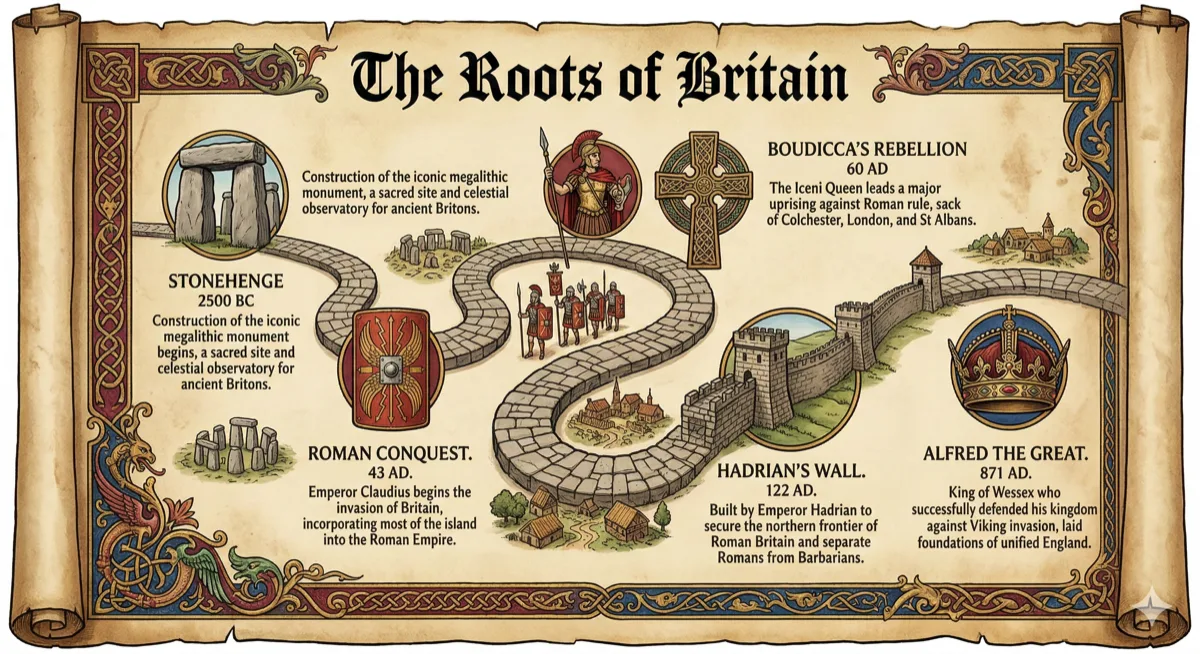
Prehistory
- Around 10,000 years ago — Britain becomes permanently separated from the European continent by the Channel.
- Around 6,000 years ago — The first farmers arrive in Britain, probably from south-east Europe. They build houses, tombs, and monuments including Stonehenge.
- Around 4,000 years ago — People learn to make bronze, marking the beginning of the Bronze Age.
Ancient and Roman Britain
- 55 BC — Julius Caesar leads an unsuccessful Roman invasion of Britain.
- AD 43 — Emperor Claudius leads a successful Roman invasion. Britain becomes part of the Roman Empire for nearly 400 years. Hadrian's Wall is built to keep out the Picts.
- 3rd–4th centuries AD — The first Christian communities appear in Britain.
- AD 410 — The Roman army leaves Britain to defend other parts of the Empire.
- Around AD 600 — Anglo-Saxon kingdoms are established across Britain.
- AD 789 — The Vikings first raid coastal towns in Britain.
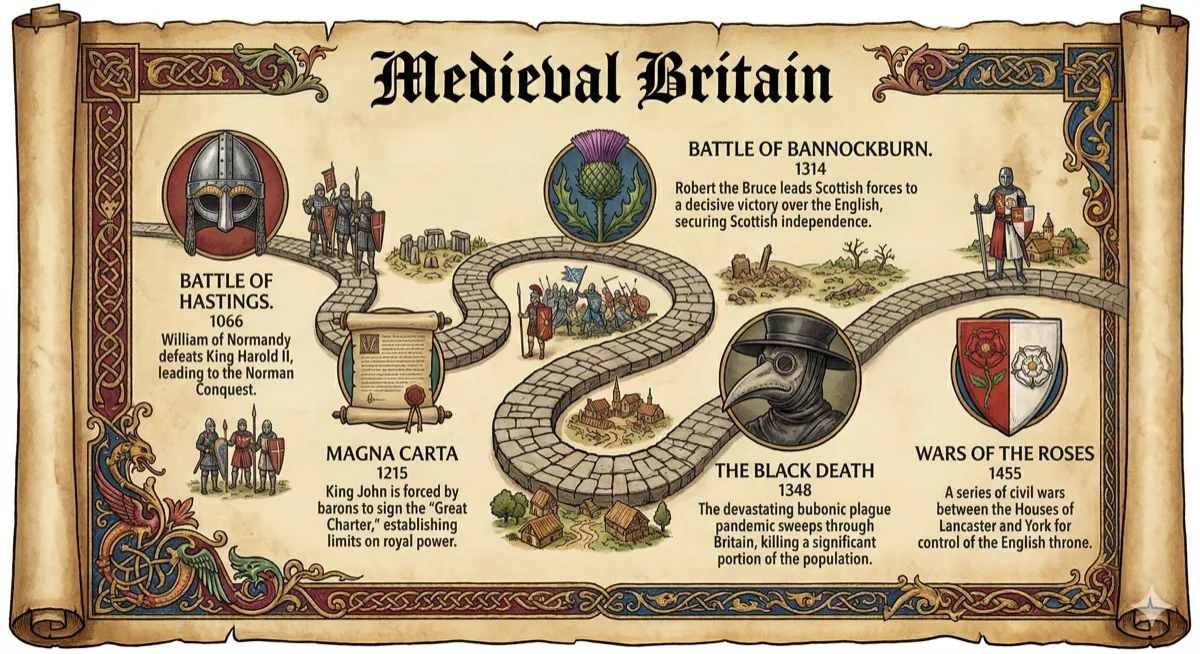
The Middle Ages (1066–1485)
- 1066 — William, Duke of Normandy, defeats King Harold at the Battle of Hastings. The Norman Conquest begins. The event is later recorded in the Bayeux Tapestry.
- 1200 — The English rule the Pale, an area around Dublin in Ireland.
- 1215 — King John is forced to agree to the Magna Carta, reducing the power of the king and establishing basic rights for the people.
- 1284 — King Edward I introduces the Statute of Rhuddlan, annexing Wales to the Crown of England.
- 1314 — Robert the Bruce defeats the English at the Battle of Bannockburn, securing Scottish independence.
- 1348 — The Black Death arrives in Britain, killing one third of England's population. It leads to labour shortages, higher wages, and the growth of a middle class.
- 1400 — English becomes the preferred language of the royal court, Parliament, and official documents.
- 1415 — King Henry V defeats the French at the Battle of Agincourt during the Hundred Years War.
- 1450s — The English leave France, ending the Hundred Years War.
- 1455 — The Wars of the Roses begin — a civil war between the House of Lancaster (red rose) and the House of York (white rose).
- 1485 — Henry Tudor defeats Richard III at the Battle of Bosworth Field and becomes King Henry VII, founding the House of Tudor. He later marries Elizabeth of York, uniting the two houses.
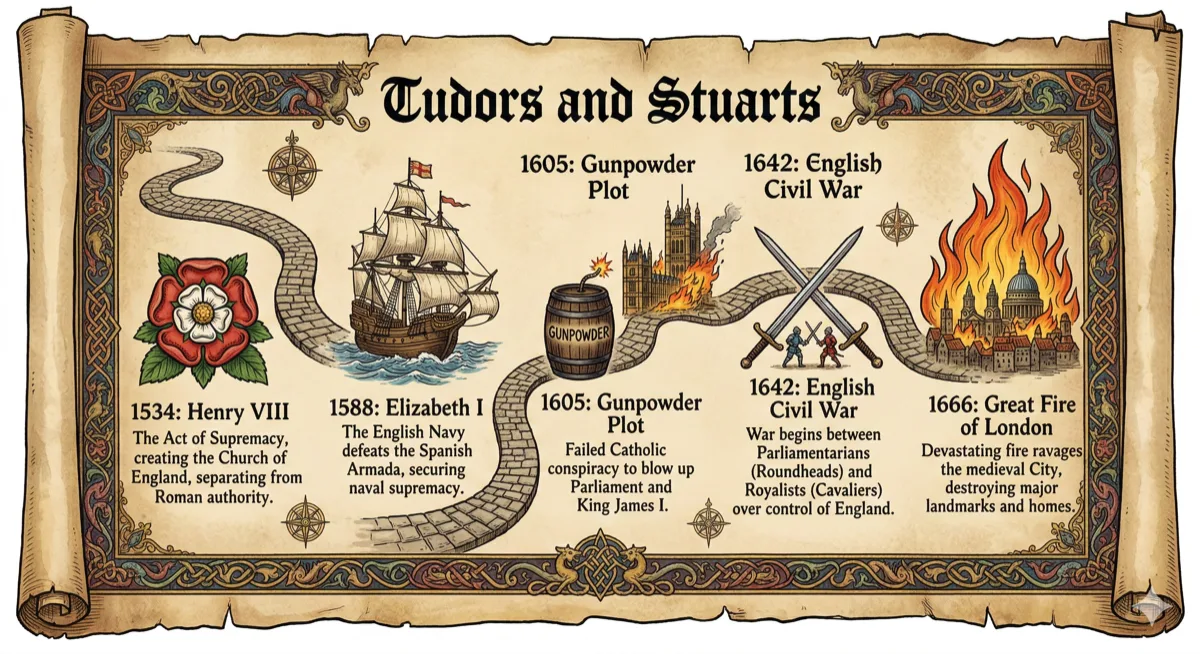
The Tudors and Stuarts (1485–1714)
- 1530s — The Reformation. King Henry VIII breaks from Rome and establishes the Church of England.
- 1560 — The Scottish Parliament abolishes the authority of the Pope in Scotland.
- 1564 — William Shakespeare is born in Stratford-upon-Avon.
- 1588 — The English defeat the Spanish Armada under Queen Elizabeth I.
- 1603 — Elizabeth I dies. James VI of Scotland becomes James I of England, uniting the crowns.
- 1605 — Guy Fawkes and a group of Catholics fail in the Gunpowder Plot to blow up Parliament. Commemorated each year on 5 November (Bonfire Night).
- 1606 — The first Union Flag is created, combining the flags of Scotland and England.
- 1616 — William Shakespeare dies.
- 1640 — Charles I recalls Parliament, beginning the events leading to the English Civil War.
- 1642 — The English Civil War begins between Cavaliers (Royalists) and Roundheads (Parliamentarians).
- 1646 — Parliament wins the Civil War. Charles I is held prisoner.
- 1649 — Charles I is executed. England is declared a republic — the Commonwealth — under Oliver Cromwell as Lord Protector.
- 1656 — The first Jews to come to Britain since the Middle Ages settle in London.
- 1658 — Oliver Cromwell dies. His son Richard briefly succeeds him as Lord Protector.
- 1660 — The Restoration: Parliament invites Charles II back from exile and he is crowned king.
- 1665 — A major outbreak of plague strikes London.
- 1666 — The Great Fire of London destroys much of the city.
- 1679 — The Habeas Corpus Act becomes law, forbidding unlawful imprisonment.
- 1680–1720 — Huguenot refugees (French Protestants) flee persecution and settle in England.
- 1685 — Charles II dies. His brother becomes King James II.
- 1688 — The Glorious Revolution: William of Orange is invited to take the English throne. James II flees to France without resistance.
- 1689 — The Bill of Rights confirms the rights of Parliament and the limits of the king's power.
- 1690 — William defeats James II at the Battle of the Boyne in Ireland.
- 1695 — Newspapers are allowed to operate without a government licence, laying foundations for a free press.
The 18th Century
- 1707 — The Act of Union creates the Kingdom of Great Britain, uniting England and Scotland.
- 1714 — Queen Anne dies. Parliament chooses George I, a German, as the next king.
- 1721–1742 — Sir Robert Walpole serves as the first Prime Minister, partly because George I spoke little English and relied on his ministers.
- 1745 — Bonnie Prince Charlie (Charles Edward Stuart) lands in Scotland to reclaim the throne.
- 1746 — Bonnie Prince Charlie is defeated at the Battle of Culloden — the last battle fought on British soil.
- 1760s — Substantial British colonies exist in North America. English settlers had been arriving since Elizabeth I's reign.
- 1776 — Thirteen American colonies declare independence, protesting taxation without representation.
- 1782 — Sake Dean Mahomet arrives in Britain from India.
- 1783 — Britain recognises the independence of the American colonies.
- 1789 — The French Revolution begins. The new French government soon declares war on Britain.
Key Figures Born This Century
- 1643–1727 — Isaac Newton, scientist and mathematician.
- 1659–1695 — Henry Purcell, composer and organist at Westminster Abbey.
- 1695–1759 — George Frederick Handel, German-born composer who becomes a British citizen in 1727.
- 1727–1788 — Thomas Gainsborough, portrait painter.
- 1732–1792 — Richard Arkwright, pioneer of the textile industry during the Industrial Revolution.
- 1757–1827 — William Blake, poet and artist.
- 1759–1796 — Robert Burns, Scotland's national poet.
- 1759–1851 — Sake Dean Mahomet, who opens the first curry house in Britain in 1810.
- 1770–1850 — William Wordsworth, poet.
- 1775–1817 — Jane Austen, novelist.
- 1775–1851 — J.M.W. Turner, landscape painter.
- 1776–1837 — John Constable, landscape painter.
- 1788–1824 — Lord Byron, poet.
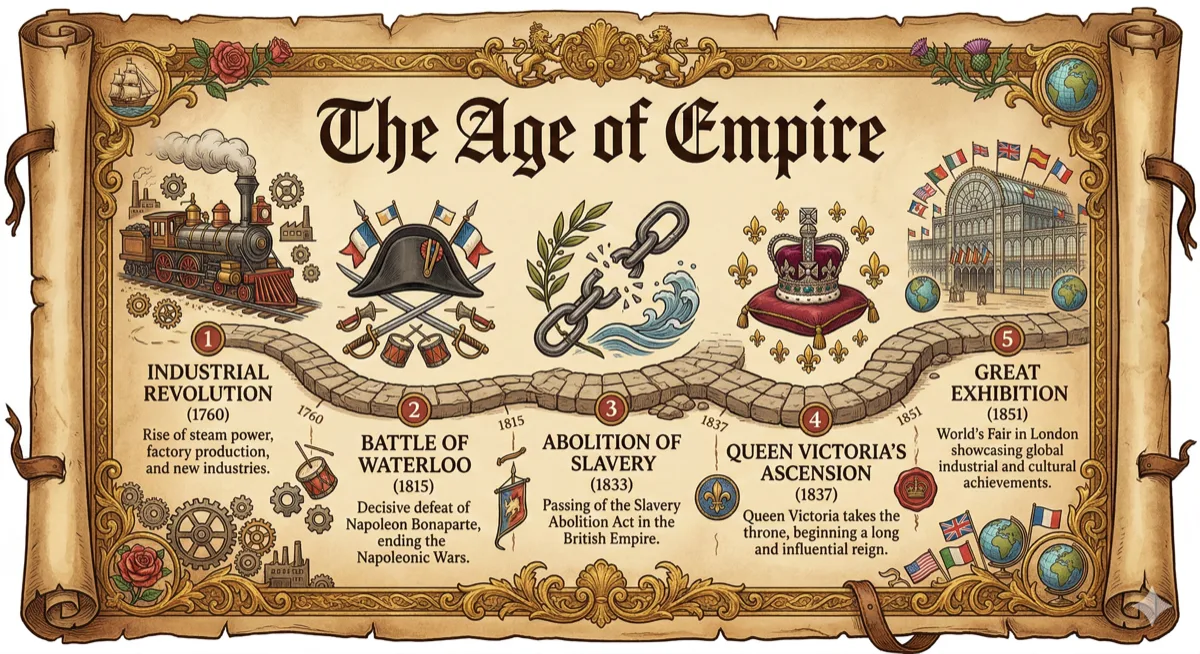
The 19th Century
- 1800 — Act of Union between Ireland and Great Britain.
- 1801 — Ireland is unified with England, Scotland, and Wales, creating the United Kingdom of Great Britain and Ireland.
- 1805 — Admiral Nelson defeats the combined French and Spanish fleets at the Battle of Trafalgar. Nelson is killed in the battle.
- 1807 — It becomes illegal to trade slaves in British ships or from British ports.
- 1810 — Sake Dean Mahomet opens the Hindoostane Coffee House in London — the first curry house in Britain.
- 1815 — The Duke of Wellington defeats Napoleon at the Battle of Waterloo, ending the French Wars.
- 1830s–1840s — The Chartists campaign for electoral reform, calling for six key changes including universal male suffrage.
- 1832 — The Reform Act greatly increases the number of people with the right to vote and abolishes pocket and rotten boroughs.
- 1833 — The Emancipation Act abolishes slavery throughout the British Empire.
- 1837 — Queen Victoria becomes queen at age 18. The Victorian Age begins — an era of expanding empire, a growing middle class, and industrial power.
- 1846 — The Corn Laws are repealed, allowing the import of cheap grain.
- 1847 — Working hours for women and children are limited to 10 hours per day.
- 1851 — The Great Exhibition opens in Hyde Park in the Crystal Palace.
- 1853–1856 — The Crimean War. Britain, Turkey, and France fight against Russia.
- 1854 — Florence Nightingale goes to Turkey to care for wounded soldiers during the Crimean War.
- 1860 — Florence Nightingale establishes the Nightingale Training School for nurses at St Thomas' Hospital.
- 1867 — A further Reform Act creates more urban seats and reduces property requirements for voting.
- 1870 — The Married Women's Property Act gives wives the right to keep their own earnings.
- 1870–1914 — Around 120,000 Russian and Polish Jews come to Britain to escape persecution.
- 1872 — The first tennis club is founded in Leamington Spa.
- 1882 — A further Act gives wives the right to keep their own property.
- 1889 — Emmeline Pankhurst founds the Women's Franchise League.
- 1895 — The National Trust is founded.
- 1896 — Films are first shown publicly in the UK.
- 1899–1902 — The Boer War in South Africa.
- 1901 — Queen Victoria dies after reigning nearly 64 years.
Key Figures Born This Century
- 1806–1859 — Isambard Kingdom Brunel, engineer.
- 1812–1870 — Charles Dickens, novelist.
- 1820–1910 — Florence Nightingale, founder of modern nursing.
- 1840–1928 — Thomas Hardy, author and poet.
- 1850–1894 — Robert Louis Stevenson, author.
- 1856–1941 — Sir John Lavery, Northern Irish portrait painter.
- 1857–1934 — Sir Edward Elgar, composer.
- 1858–1928 — Emmeline Pankhurst, suffragette leader.
- 1859–1930 — Sir Arthur Conan Doyle, author of Sherlock Holmes.
- 1865–1936 — Rudyard Kipling, author and Nobel Prize winner (1907).
- 1872–1958 — Ralph Vaughan Williams, composer.
- 1874–1934 — Gustav Holst, composer.
- 1874–1965 — Winston Churchill.
- 1876–1935 — John MacLeod, co-discoverer of insulin.
- 1879–1963 — William Beveridge, architect of the welfare state.
- 1881–1955 — Alexander Fleming, discoverer of penicillin.
- 1883–1967 — Clement Attlee, post-war Prime Minister.
- 1888–1946 — John Logie Baird, television pioneer.
- 1892–1973 — Sir Robert Watson-Watt, developer of radar.
- 1893–1918 — Wilfred Owen, war poet.
- 1898–1986 — Henry Moore, sculptor.
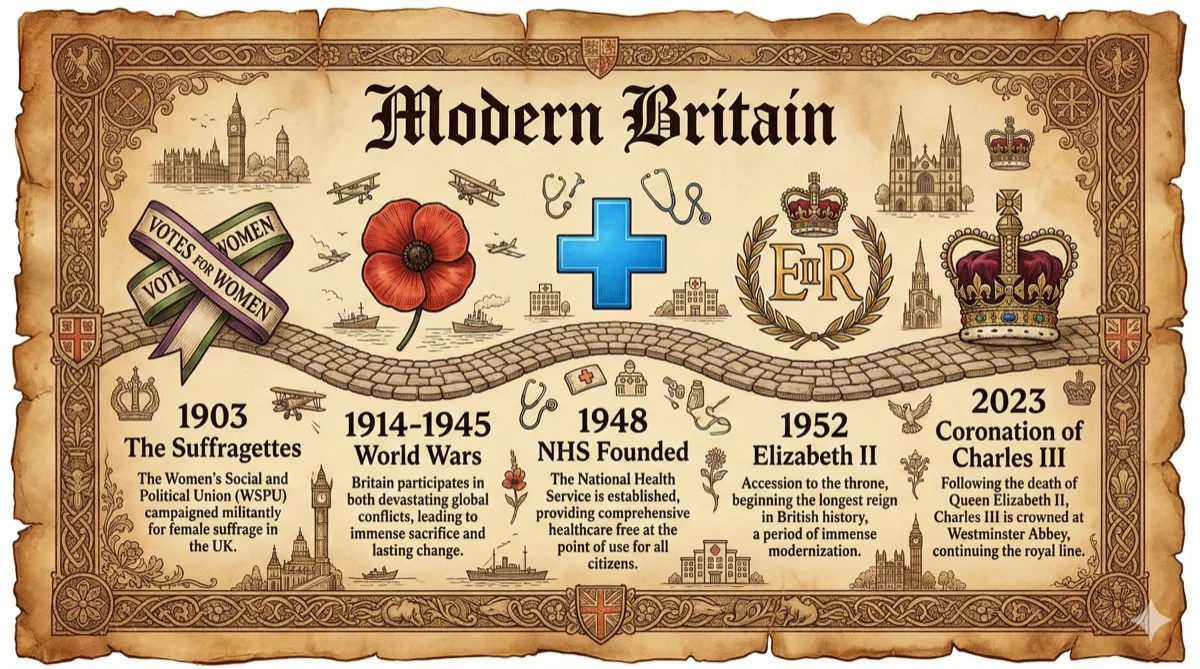
The Early 20th Century (1900–1939)
- 1900 — Winston Churchill becomes a Conservative MP.
- 1902 — Motor-car racing begins in the UK.
- 1903 — Emmeline Pankhurst helps found the Women's Social and Political Union (WSPU), escalating the campaign for women's suffrage.
- 1907 — Rudyard Kipling is awarded the Nobel Prize in Literature.
- 1908 — London hosts the Olympic Games for the first time.
- 1913 — The British government promises Home Rule for Ireland, but World War I delays it.
- 28 June 1914 — Archduke Franz Ferdinand of Austria is assassinated, triggering events leading to war.
- 1914–1918 — The First World War. Britain fights alongside allies against Germany and the Central Powers.
- July 1916 — The Battle of the Somme: approximately 60,000 British casualties on the first day alone.
- 1916 — The Easter Rising: Irish nationalists rebel against British rule in Dublin.
- 11 November 1918 — The First World War ends at 11:00 am. Remembered each year on Remembrance Day.
- 1918 — Women over 30 are given the right to vote and the right to stand for Parliament.
- 1920s — The British Empire continues to grow. Television is developed by John Logie Baird. Public housing improves.
- 1921 — A peace treaty is signed between Britain and Ireland.
- 1922 — Ireland is partitioned. Northern Ireland remains in the UK; the Irish Free State is established. The BBC begins radio broadcasts. A Northern Ireland Parliament is established at Stormont.
- 1927 — The BBC begins organising the Proms.
- 1928 — Women gain the right to vote at 21 — the same age as men. Alexander Fleming discovers penicillin.
- 1929 — The Great Depression begins, bringing high unemployment especially in heavy industries.
- 1930–1939 — Car ownership doubles from 1 million to 2 million.
- 1932 — John Logie Baird makes the first television broadcast between London and Glasgow.
- 1933 — Adolf Hitler comes to power in Germany.
- 1935 — The first successful radar test, developed by Sir Robert Watson-Watt.
- 1936 — The BBC begins the world's first regular television service.
- 1939 — Hitler invades Poland. Britain and France declare war on Germany.
The Second World War (1939–1945)
- 1940 — Winston Churchill becomes Prime Minister. German forces advance through Western Europe. The Dunkirk evacuation rescues 300,000 men. The Battle of Britain is fought in the skies over southern England. The Blitz begins — German bombing of British cities.
- 1941 — The Beveridge Report is commissioned. Germany invades the Soviet Union. Japan bombs Pearl Harbor in December, bringing the United States into the war.
- 1942 — The Beveridge Report is published, laying the foundations of the modern welfare state.
- 6 June 1944 — D-Day: Allied forces land in Normandy, beginning the liberation of Western Europe.
- 1944 — The Education Act (the Butler Act) introduces free secondary education in England and Wales.
- May 1945 — Germany is defeated. The war in Europe ends.
- August 1945 — The United States drops atomic bombs on Hiroshima and Nagasaki. Japan surrenders.
Post-War Britain (1945–1959)
- 1945 — The Labour Party wins the General Election. Clement Attlee becomes Prime Minister. Major industries are nationalised and the foundations of the NHS are laid. Alexander Fleming wins the Nobel Prize in Medicine.
- 1947 — Independence is granted to nine countries, including India, Pakistan, and Ceylon (Sri Lanka).
- 1948 — Aneurin (Nye) Bevan establishes the National Health Service (NHS). Workers from the West Indies are invited to come to Britain. London hosts the Olympic Games for the second time.
- 1949 — Ireland becomes a republic.
- 1950 — The UK is one of the first countries to sign the European Convention on Human Rights.
- 1950s — A period of economic recovery. Labour shortages lead to immigration from India, Pakistan, the West Indies, and Bangladesh. Sir Christopher Cockerell invents the hovercraft.
- 1951 — A Conservative government is elected. Churchill returns as Prime Minister.
- 1952 — Queen Elizabeth II's reign begins. The Mousetrap by Agatha Christie opens in the West End.
- 1953 — The structure of the DNA molecule is discovered (Francis Crick and James Watson).
- 1954 — Sir Roger Bannister runs a mile in under four minutes.
- 1957 — Six western European countries form the European Economic Community (EEC). The Treaty of Rome is signed on 25 March.
- 1958 — Life peers are introduced — the Prime Minister can nominate members of the House of Lords for their lifetime.
- 1959 — Margaret Thatcher is elected as a Conservative MP.
The 1960s and 1970s
- 1960s — "The Swinging Sixties": a cultural revolution. The Beatles and The Rolling Stones transform pop music. Social laws are liberalised. Britain and France develop Concorde. James Goodfellow invents the ATM.
- 1964 — Churchill stands down from Parliament.
- 1965 — Churchill dies and is given a state funeral.
- 1966 — England wins the FIFA World Cup, hosted in the UK. Bobby Moore captains the team.
- 1966/67 — Sir Francis Chichester becomes the first person to sail single-handed around the world.
- 1967 — The first ATM is put into use by Barclays Bank in Enfield, north London.
- 1968 — The Man Booker Prize for Fiction is first awarded.
- 1969 — Concorde makes its first flight. The voting age is reduced to 18. Sir Robin Knox-Johnston becomes the first person to sail non-stop around the world. The Troubles escalate in Northern Ireland.
- 1970 — Margaret Thatcher becomes Secretary of State for Education and Science.
- Early 1970s — Britain admits 28,000 people of Indian origin expelled from Uganda.
- 1972 — The Northern Ireland Parliament is suspended. Mary Peters wins Olympic gold in the pentathlon.
- 1973 — The UK joins the European Economic Community (EEC).
- 1975 — Margaret Thatcher is elected Leader of the Conservative Party.
- 1976 — Concorde begins carrying passengers.
- 1978 — The world's first "test-tube baby" is born in Oldham, Lancashire — a breakthrough in IVF.
- 1979 — Margaret Thatcher becomes the first woman Prime Minister.
The 1980s and 1990s
- 1982 — Argentina invades the Falkland Islands. A British naval task force recovers the islands.
- 1984 — The Turner Prize is established. Torvill and Dean win Olympic gold in ice dancing.
- 1990 — Margaret Thatcher leaves office as the longest-serving Prime Minister of the 20th century. Iraq invades Kuwait.
- 25 December 1990 — Information is successfully transferred via the World Wide Web for the first time, invented by Sir Tim Berners-Lee.
- 1996 — Dolly the sheep is cloned by Sir Ian Wilmut and Keith Campbell — the first successfully cloned mammal.
- 1997 — The Labour Party, led by Tony Blair, wins the General Election. Devolution begins with a Scottish Parliament and Welsh Assembly.
- 1998 — The Good Friday Agreement is signed, establishing the Northern Ireland Assembly. The Human Rights Act incorporates the European Convention on Human Rights into UK law.
- 1999 — The Scottish Parliament and Northern Ireland Assembly begin sitting. Hereditary peers lose the automatic right to attend the House of Lords.
The 21st Century
- 2002 — Winston Churchill is voted the greatest Briton of all time.
- 2003 — Concorde is retired from service.
- 2004 — Dame Kelly Holmes wins two Olympic gold medals. Dame Ellen MacArthur becomes the fastest person to sail around the world single-handed.
- 2007 — The Northern Ireland Assembly is reinstated. Gordon Brown becomes Prime Minister.
- 2008 — Forced Marriage Protection Orders are introduced in England, Wales, and Northern Ireland.
- 2009 — British combat troops leave Iraq.
- May 2010 — A coalition government is formed between Conservatives and Liberal Democrats. David Cameron becomes Prime Minister.
- 2011 — The Welsh Assembly gains the power to pass laws without agreement from the UK Parliament.
- 2012 — London hosts the Olympic and Paralympic Games for the third time. Queen Elizabeth II celebrates her Diamond Jubilee. Mo Farah wins double Olympic gold. Jessica Ennis wins heptathlon gold. Andy Murray wins the US Open. Bradley Wiggins becomes the first Briton to win the Tour de France.
- 2016 — The EU membership referendum takes place. The UK votes to leave the European Union (Brexit).
- 31 January 2020 — Brexit officially takes place at 23:00 GMT.
- 8 September 2022 — Queen Elizabeth II dies after 70 years on the throne. King Charles III becomes the sovereign.
- 2023 — Prince Edward becomes the Duke of Edinburgh.
- 4 July 2024 — A General Election is held. The Labour Party, led by Keir Starmer, wins and forms the government.
UK Population Over Time
| Year | Population |
|---|---|
| 1600 | ~4 million |
| 1700 | ~5 million |
| 1801 | ~8 million |
| 1851 | ~20 million |
| 1901 | ~40 million |
| 1951 | ~50 million |
| 1998 | ~57 million |
| 2005 | ~60 million |
| 2010 | ~62 million |
| 2022 | ~67.6 million |