Complete Guide to British History Questions in the Life in the UK Test
Why British History Matters for Your Test
British history makes up the largest portion of the Life in the UK test. Chapter 3 of the official handbook, "A Long and Illustrious History," is the longest chapter and generates the most questions. Understanding this history is not just about passing a test—it helps you appreciate the cultural heritage of your new home.
This guide breaks down every major historical period you need to know, organised chronologically for easy studying.
Prehistoric and Ancient Britain
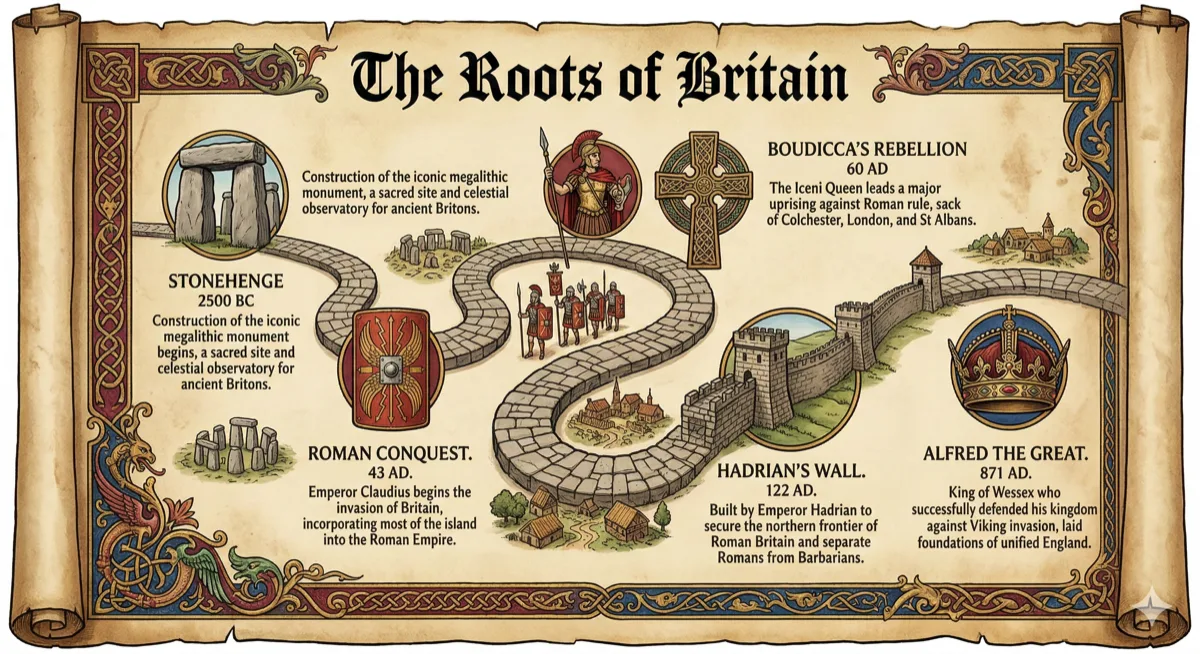
The Stone Age (before 4000 BC)
Britain was not always an island. During the last Ice Age, a land bridge connected Britain to continental Europe. Early humans could walk between what is now Britain and France. The first permanent settlers arrived around 10,000 years ago as the ice retreated.
Key points to remember: - Stonehenge was built during the Stone Age, around 3000 BC - Early Britons were hunter-gatherers who gradually developed farming - The land bridge to Europe was eventually flooded, making Britain an island
The Bronze Age (2000-800 BC)
The Bronze Age brought significant advances. People learned to work with bronze (a mixture of copper and tin), creating better tools and weapons. This period saw the construction of many stone monuments across Britain.
The Iron Age (800 BC - 43 AD)
The Iron Age introduced stronger metal tools and the first Celtic settlements. The Celts came from central Europe and brought their language, which evolved into Welsh, Irish, and Scottish Gaelic.
Remember: The Celtic languages are still spoken today in parts of Wales, Scotland, Ireland, and Cornwall.
Roman Britain (43 AD - 410 AD)
The Roman Invasion
In 43 AD, Emperor Claudius ordered the invasion of Britain. The Romans successfully conquered much of what is now England and Wales. They tried to conquer Scotland but were ultimately unsuccessful.
Key Roman contributions: - Hadrian's Wall - Built on the orders of Emperor Hadrian to mark the northern boundary of the Roman Empire - Road networks that connected major settlements - Towns such as London (Londinium), York (Eboracum), and Bath (Aquae Sulis) - Introduction of Christianity toward the end of Roman rule
The End of Roman Britain
By 410 AD, the Roman army had left Britain to defend other parts of the empire. This left Britain vulnerable to invasion and marked the beginning of the Anglo-Saxon period.
The Anglo-Saxons and Vikings (410 AD - 1066)
Anglo-Saxon Settlement
After the Romans left, tribes from northern Europe—the Angles, Saxons, and Jutes—began settling in Britain. They established several kingdoms, and their language formed the foundation of modern English.
Important kingdoms: - Wessex (in the south) - Mercia (in the midlands) - Northumbria (in the north)
King Alfred the Great
Alfred the Great (849-899) is one of the most important figures in this period. He was King of Wessex and is famous for: - Successfully fighting against Viking invaders - Being the only English monarch called "the Great" - Promoting education and learning - Establishing a legal code
The Vikings
From the 8th century onwards, Vikings from Denmark and Norway began raiding and eventually settling in Britain. They established the Danelaw, a region in northern and eastern England under Viking control.
Key fact: Many English words and place names come from Old Norse (the Viking language). Towns ending in "-by" (such as Whitby or Derby) have Viking origins.
The Norman Conquest (1066)
The Battle of Hastings
1066 is arguably the most important date in British history. When King Edward the Confessor died without an heir, three men claimed the throne: - Harold Godwinson - English nobleman, crowned king - William, Duke of Normandy - claimed Edward promised him the throne - Harald Hardrada - King of Norway
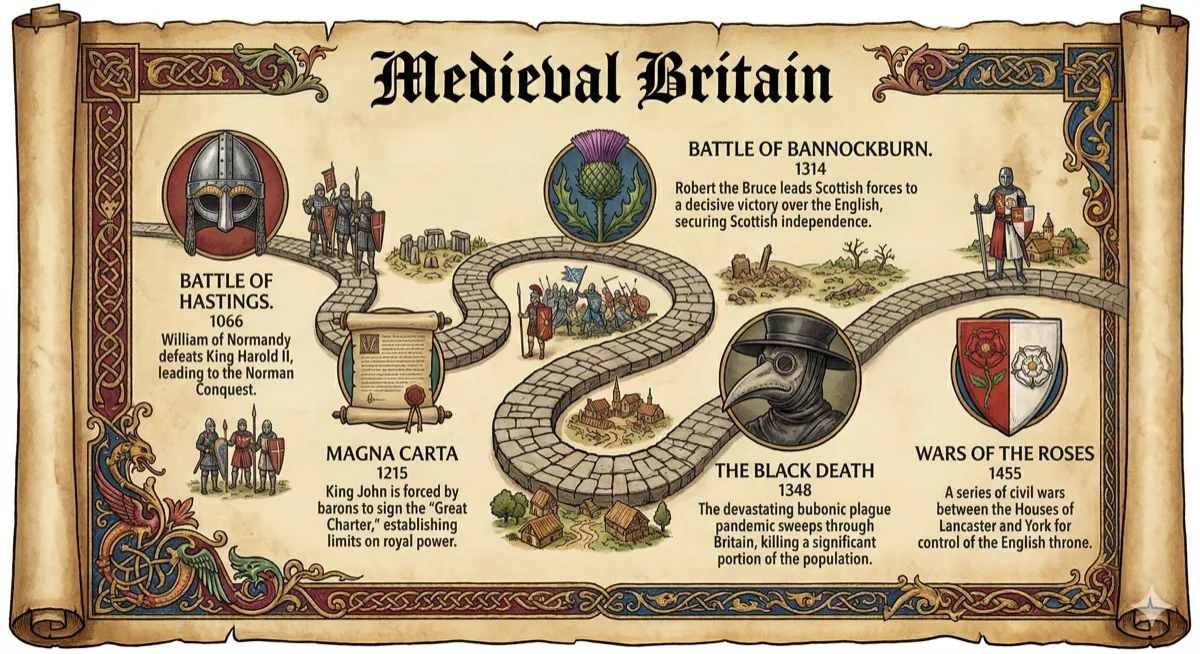
Harold first defeated Harald Hardrada at the Battle of Stamford Bridge in northern England. He then marched south to face William at the Battle of Hastings on 14 October 1066. Harold was killed (legend says by an arrow to the eye), and William became King of England.
Norman Rule
William the Conqueror (William I) transformed England: - The Domesday Book (1086) - A comprehensive survey of land and property in England, used for taxation - Building of stone castles throughout England - The feudal system, where land was granted in exchange for military service - French became the language of the court and nobility
The Middle Ages (1066-1485)
Magna Carta (1215)
When King John raised taxes and imprisoned enemies without trial, English barons forced him to sign Magna Carta (Latin for "Great Charter"). This document established that: - The king was subject to the law - There could be no taxation without consultation - People had a right to a fair trial
Remember: Magna Carta is considered a foundation of the rule of law and influenced the development of constitutional government worldwide.
The Black Death (1348)
The Black Death (bubonic plague) killed approximately one-third of the population of Britain. This had profound social consequences: - Labour shortages gave peasants more bargaining power - Wages increased as workers became scarce - The feudal system began to break down
The Wars of the Roses (1455-1485)
This was a civil war between two branches of the royal family: - House of Lancaster (red rose symbol) - House of York (white rose symbol)
The war ended when Henry Tudor (Lancastrian) defeated Richard III (Yorkist) at the Battle of Bosworth Field in 1485. Henry became Henry VII and founded the Tudor dynasty.
The Tudors (1485-1603)
Henry VIII
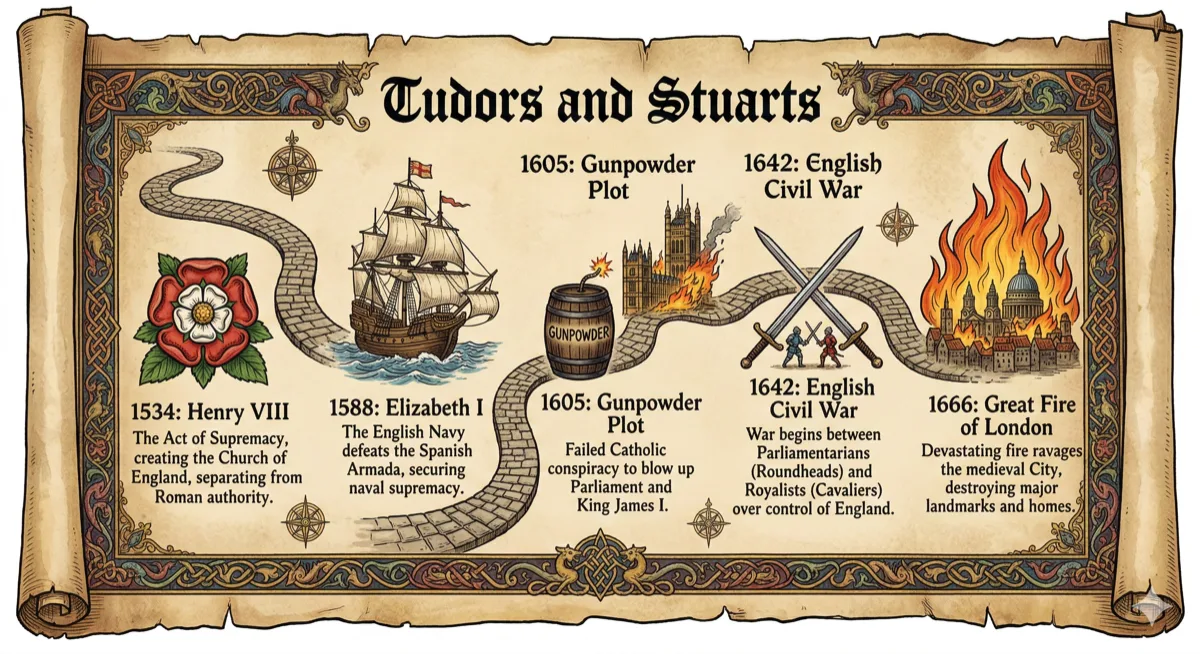
Henry VIII (reigned 1509-1547) is famous for having six wives and for breaking with the Catholic Church. When the Pope refused to annul his marriage to Catherine of Aragon, Henry established the Church of England with himself as head.
Henry's six wives (in order): 1. Catherine of Aragon - divorced 2. Anne Boleyn - executed 3. Jane Seymour - died in childbirth 4. Anne of Cleves - divorced 5. Catherine Howard - executed 6. Catherine Parr - survived
Helpful rhyme: "Divorced, beheaded, died, divorced, beheaded, survived"
The Reformation
The split from Rome led to the Reformation in England. Monasteries were dissolved (closed), and their wealth went to the crown. The Church of England (Anglican Church) was established as a Protestant church.
Elizabeth I
Elizabeth I (reigned 1558-1603) is considered one of England's greatest monarchs. Her reign, known as the Elizabethan era, was a golden age of: - Theatre - William Shakespeare wrote many of his plays during this time - Exploration - Sir Francis Drake became the first Englishman to sail around the world - Naval power - The defeat of the Spanish Armada in 1588
The Stuarts and Civil War (1603-1714)
James I and the Union of Crowns
When Elizabeth I died childless, James VI of Scotland became James I of England, uniting the crowns of England and Scotland in 1603. Important events of his reign include: - The Gunpowder Plot (1605) - A group of Catholics, including Guy Fawkes, tried to blow up Parliament. This is remembered every November 5th with bonfires and fireworks. - The King James Bible (1611) - An influential English translation of the Bible
The English Civil War (1642-1651)
A conflict between King Charles I (who believed in the divine right of kings) and Parliament. The war ended with: - Charles I's execution in 1649 - England becoming a republic (the Commonwealth) under Oliver Cromwell - The restoration of the monarchy in 1660 when Charles II became king
The Glorious Revolution (1688)
When the Catholic James II became king, Parliament invited the Protestant William of Orange (from the Netherlands) to take the throne. James fled, and this peaceful transfer of power established: - Parliament's supremacy over the monarchy - The Bill of Rights (1689), which limited royal power - The principle that monarchs rule by consent, not divine right
The Georgians and Empire (1714-1837)
The Hanoverian Succession
The Act of Settlement 1701 ensured that only Protestants could inherit the throne. When Queen Anne died, the crown passed to George I from Hanover (Germany). The House of Hanover ruled Britain until 1901.
The Growth of the British Empire
During the 18th and 19th centuries, Britain built the largest empire in history. Key developments included: - The colonisation of Australia (1788) - Control of India - Territories in Africa, the Caribbean, and Canada
The Industrial Revolution
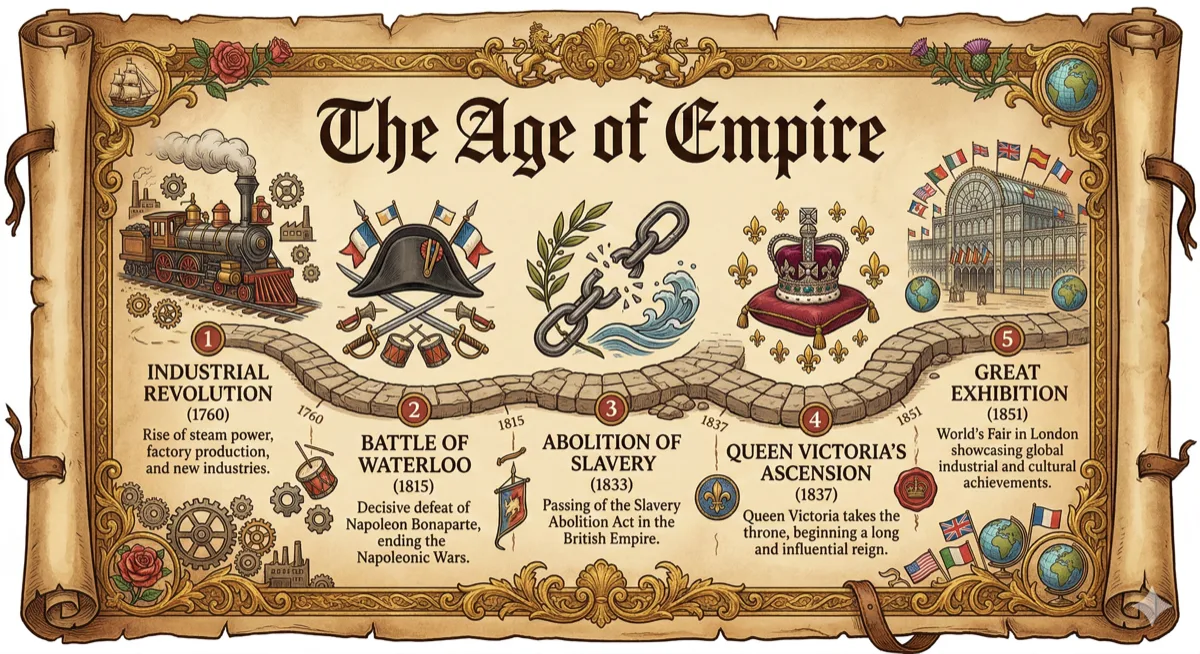
Britain was the first country to industrialise. Starting in the late 18th century: - New machines transformed textile manufacturing - Steam power revolutionised transport (railways) and manufacturing - People moved from rural areas to cities for factory work - Britain became the world's leading industrial and economic power
Key figures: - James Watt - Improved the steam engine - George Stephenson - Built the first public railway (Stockton to Darlington, 1825) - Isambard Kingdom Brunel - Engineer who built bridges, tunnels, and ships
The Victorian Era (1837-1901)
Queen Victoria reigned for 63 years, the longest reign until Elizabeth II. This era saw: - Britain at the height of its imperial power - Continued industrial growth - Social reforms including the expansion of voting rights - The abolition of slavery throughout the British Empire (1833)
Key reforms: - The Great Reform Act (1832) - Extended voting rights - The Slavery Abolition Act (1833) - Factory Acts improving working conditions - The Education Act (1870) making elementary education available to all
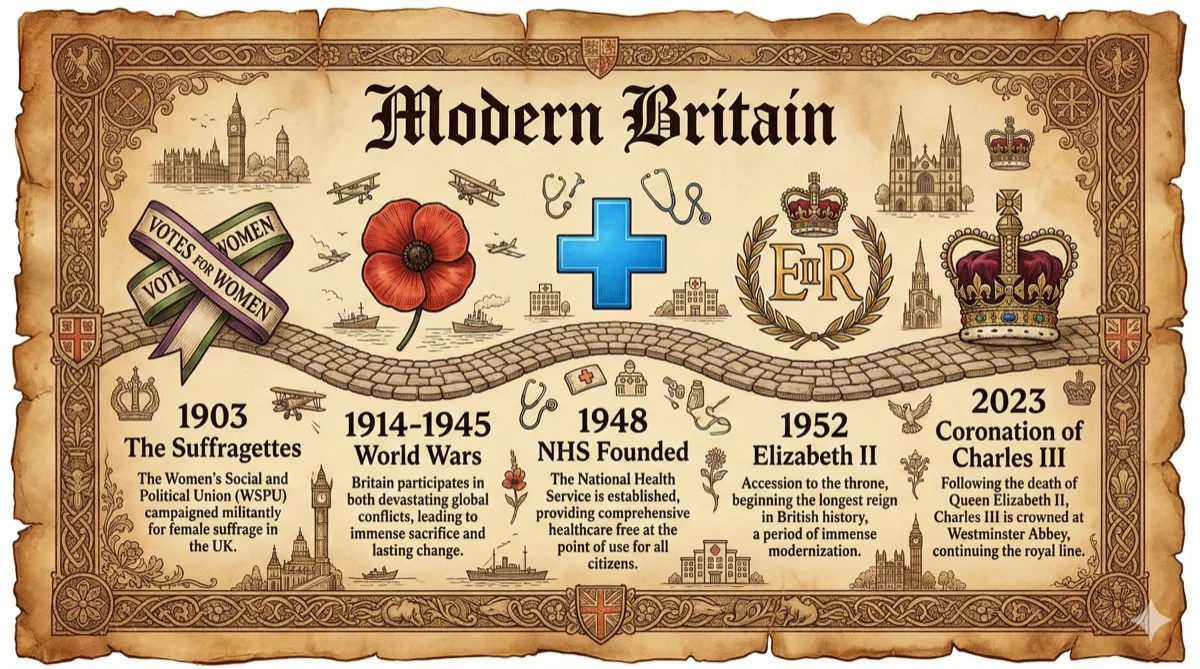
The 20th Century and Beyond
World War I (1914-1918)
Britain and its allies (including France and Russia) fought against Germany and Austria-Hungary. Key points: - Over 700,000 British soldiers died - Women entered the workforce in large numbers - The war ended on 11 November 1918 (now Remembrance Day)
Women's Suffrage
Women campaigned for the right to vote: - Suffragettes (led by Emmeline Pankhurst) used direct action - Women over 30 gained the vote in 1918 - Equal voting rights (age 21) were granted in 1928
World War II (1939-1945)
Britain declared war on Germany after the invasion of Poland. Key events: - The Battle of Britain (1940) - The RAF defended against German air attacks - The Blitz - German bombing of British cities - D-Day (6 June 1944) - Allied invasion of Nazi-occupied France - Winston Churchill - Prime Minister who led Britain through the war
Post-War Britain
After WWII, Britain saw major changes: - The National Health Service (NHS) established in 1948 - The welfare state providing social security - Decolonisation - most former colonies gained independence - Britain joined the European Economic Community (now EU) in 1973 (and left in 2020)
Tips for Remembering Historical Dates
Focus on these key dates: - 1066 - Battle of Hastings (Norman Conquest) - 1215 - Magna Carta signed - 1485 - Battle of Bosworth Field (end of Wars of the Roses) - 1588 - Defeat of the Spanish Armada - 1605 - Gunpowder Plot - 1688 - Glorious Revolution - 1801 - Act of Union with Ireland - 1833 - Abolition of slavery - 1918 - End of WWI, women gain partial voting rights - 1928 - Equal voting rights for women - 1948 - NHS established
Practice Makes Perfect
Understanding British history takes time, but it is manageable with consistent study. Use our flashcards and practice tests to reinforce your knowledge. Focus on: - Key dates and what they represent - Important monarchs and what they achieved - Major documents (Magna Carta, Bill of Rights) - How historical events connect to modern British values
Good luck with your studies!