Every Famous Person in the Life in the UK Test: The Complete Guide
By Life in the UK Test Prep Team
british-history
study-guide
famous-people
The Life in the UK test expects you to recognise over 200 named individuals — and know what each one is famous for. That is a lot of names.
This guide lists every person from the official handbook, grouped by their area of activity. Instead of memorising a wall of names, you can focus on each category and build connections between people in the same field.
Monarchs and Rulers
These are the kings, queens, and rulers you need to know, in chronological order.
Ancient and Medieval Rulers
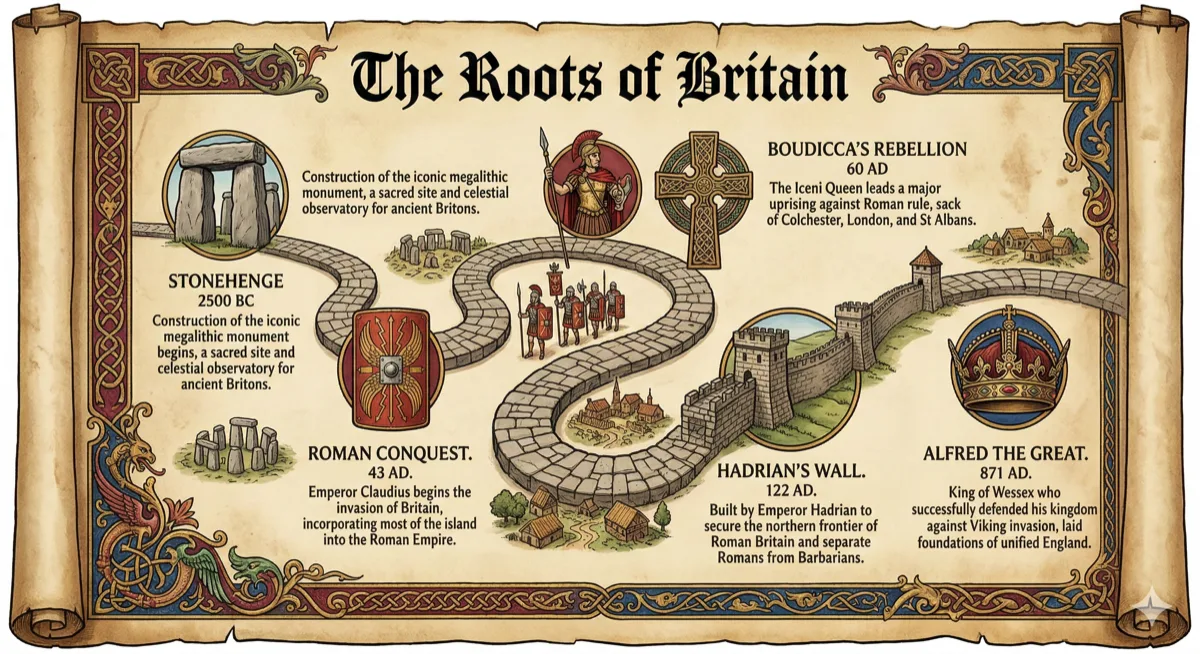
- Boudicca — Queen of the Iceni tribe in eastern England. Fought against the Romans. Her statue stands on Westminster Bridge, London.
- King Alfred the Great — United the Anglo-Saxon kingdoms of England and defeated the Vikings.
- Cnut (Canute) — The first Danish king to rule England.
- Kenneth MacAlpin — United the people of northern Scotland under one king. The term "Scotland" began to be used.
- William the Conqueror — Duke of Normandy. Defeated King Harold at the Battle of Hastings (1066). Ordered the Domesday Book and built the Tower of London.
- King John — Forced by his noblemen to sign the Magna Carta (1215), limiting the king's power.
- King Edward I — Introduced the Statute of Rhuddlan (1284), annexing Wales to the Crown of England.
- Robert the Bruce — Led the Scots to defeat the English at the Battle of Bannockburn (1314).
- King Henry V — Led a vastly outnumbered English army to victory at the Battle of Agincourt (1415).
- King Richard III — House of York. Killed at the Battle of Bosworth Field (1485).
The Tudors
- King Henry VII (Henry Tudor) — Won the Battle of Bosworth Field and founded the House of Tudor. Married Elizabeth of York to unite the houses of Lancaster and York.
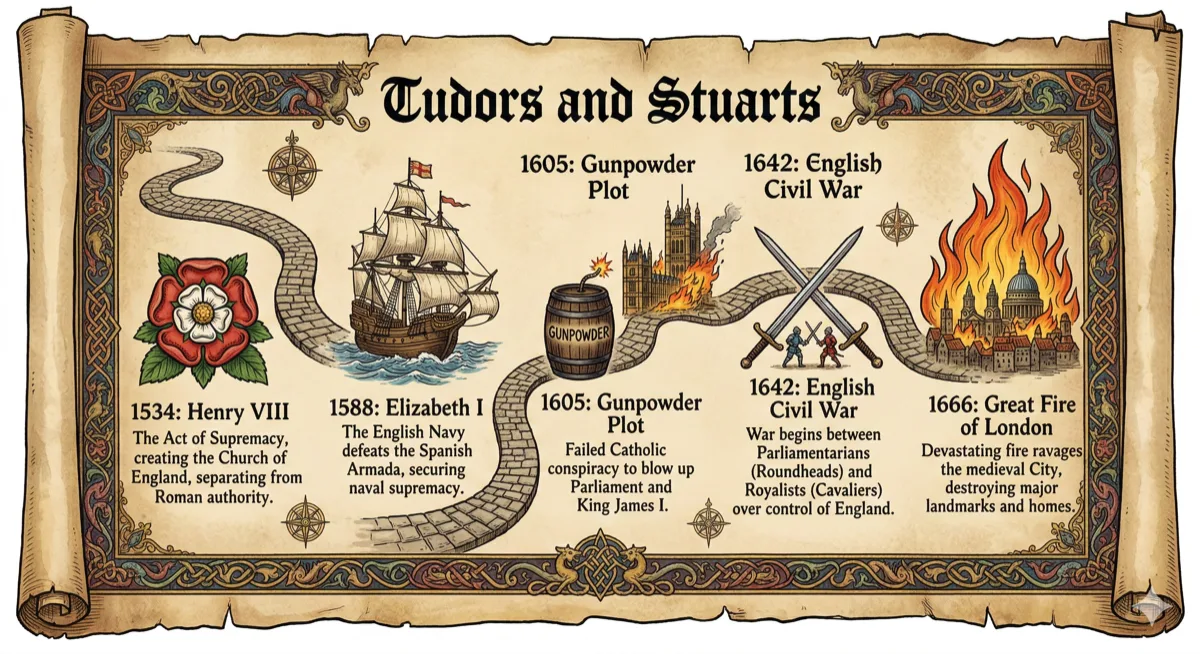
- King Henry VIII — Broke from the Church of Rome, established the Church of England, and married six times.
- Catherine of Aragon — First wife of Henry VIII. Spanish princess; mother of Mary.
- Anne Boleyn — Second wife. Mother of Elizabeth. Executed at the Tower of London.
- Jane Seymour — Third wife. Mother of Edward VI. Died shortly after childbirth.
- Anne of Cleves — Fourth wife. German princess; married for political reasons, divorced soon after.
- Catherine Howard — Fifth wife. Cousin of Anne Boleyn. Executed.
- Catherine Parr — Sixth wife. A widow who survived Henry VIII.
- King Edward VI — Son of Henry VIII. Strongly Protestant. The Book of Common Prayer was written during his reign. Died at age 15.
- Queen Mary I ("Bloody Mary") — Devout Catholic who persecuted Protestants.
- Queen Elizabeth I — Re-established the Church of England. Defeated the Spanish Armada (1588). Never married. One of the most popular monarchs in English history.
The Stuarts
- Mary, Queen of Scots — Catholic queen of Scotland. Fled to England, kept prisoner by Elizabeth I for 20 years, then executed for plotting against her.
- King James I (James VI of Scotland) — United the crowns of England and Scotland in 1603. Commissioned the King James Bible.
- King Charles I — Believed in the Divine Right of Kings. Precipitated the English Civil War. Executed in 1649.
- King Charles II — Restored to the throne in 1660 (the Restoration). Interested in science; founded the Royal Society.
- King James II — Catholic brother of Charles II. Fled during the Glorious Revolution (1688). Defeated at the Battle of the Boyne (1690).
- William III (William of Orange) — Protestant ruler of the Netherlands. Invited to take the throne in 1688. Ruled jointly with Queen Mary II.
- Queen Anne — Last Stuart monarch. The Act of Union (1707) was agreed during her reign.
The Hanoverians to the Present
- King George I — A German chosen by Parliament as king in 1714. Spoke little English, leading to the rise of the Prime Minister.
- Charles Edward Stuart (Bonnie Prince Charlie) — Grandson of James II. Led a Jacobite rebellion in 1745. Defeated at the Battle of Culloden (1746).
- Queen Victoria — Reigned 1837–1901 (almost 64 years). The Victorian Age: Britain became the largest empire the world had ever seen.
- Queen Elizabeth II — Reigned 1952–2022. Celebrated her Diamond Jubilee in 2012. Died on 8 September 2022.
- King Charles III — Became sovereign in 2022. Ceremonial head of the Commonwealth.
Prime Ministers and Political Leaders
- Sir Robert Walpole — The first Prime Minister. Served 1721–1742, partly because George I spoke poor English and relied on his ministers.
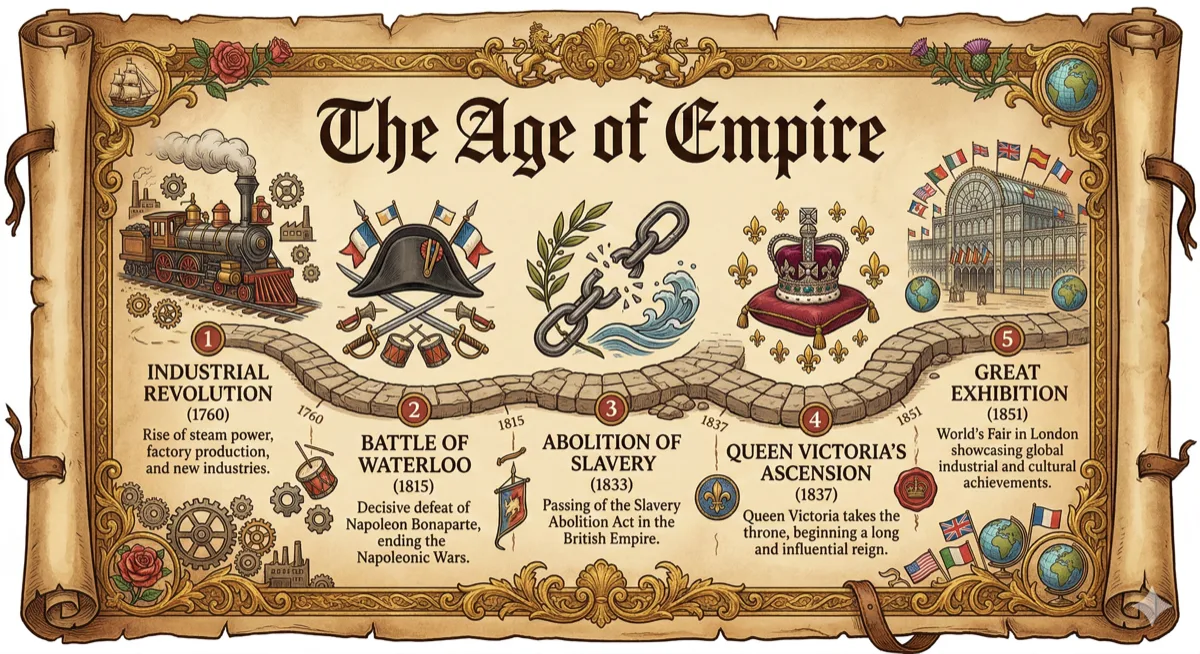
- Duke of Wellington — Defeated Napoleon at Waterloo (1815). Known as the "Iron Duke." Later became Prime Minister.
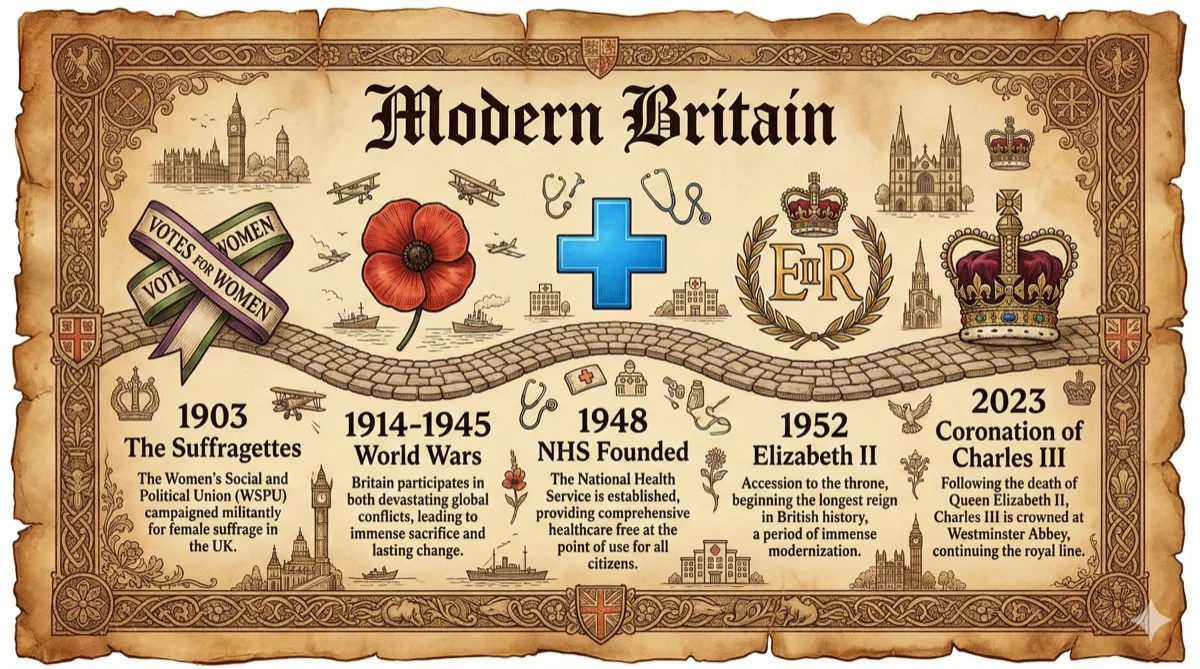
- Clement Attlee (1883–1967) — Labour PM 1945–1951. Nationalised major industries and created the NHS.
- Winston Churchill (1874–1965) — PM during WWII from 1940. Refused to surrender to the Nazis. Returned as PM in 1951. Given a state funeral. Voted the greatest Briton of all time in 2002.
- Harold Macmillan — Conservative PM in the 1950s. Famous for his "wind of change" speech about decolonisation.
- Margaret Thatcher (1925–2013) — First woman PM (1979–1990). Longest-serving PM of the 20th century. Privatised nationalised industries. Worked closely with US President Ronald Reagan.
- John Major — PM after Thatcher. Helped establish the Northern Ireland peace process.
- Tony Blair — Labour PM from 1997. Introduced the Scottish Parliament and Welsh Assembly. The Good Friday Agreement (1998) was signed during his leadership.
- Gordon Brown — Became PM in 2007.
- David Cameron — Led the Conservative-Liberal Democrat coalition from 2010.
- Keir Starmer — Labour leader who won the 2024 General Election.
Social Reformers and Activists
- William Wilberforce — Evangelical Christian and MP. Played a key role in abolishing the slave trade (1807) and slavery (1833).
- Emmeline Pankhurst (1858–1928) — Founded the Women's Franchise League (1889) and co-founded the WSPU (1903). Led the suffragette movement using civil disobedience, hunger strikes, and protest.
- William Beveridge (1879–1963) — Authored the Beveridge Report (1942), which recommended fighting the five "Giant Evils" and laid the foundations of the modern welfare state.
- R. A. Butler (1902–1982) — Oversaw the Education Act 1944 (the Butler Act), which introduced free secondary education.
- Aneurin (Nye) Bevan — Minister for Health who led the establishment of the NHS in 1948.
Military Leaders and Explorers
Military
- Emperor Hadrian — Roman emperor who built Hadrian's Wall to keep out the Picts.
- Admiral Nelson — Defeated the French and Spanish fleets at the Battle of Trafalgar (1805). Killed in the battle. Commemorated by Nelson's Column in Trafalgar Square.
- Guy Fawkes — Led a group of Catholics in the failed Gunpowder Plot (1605). Commemorated on Bonfire Night (5 November).
- Oliver Cromwell — Parliamentary general in the Civil War. Titled Lord Protector of the English republic. Controversial for his violent campaign in Ireland.
Explorers and Navigators
- Sir Francis Drake — Elizabethan explorer and naval commander. His ship the Golden Hind was one of the first to sail around the world. Helped defeat the Spanish Armada.
- Captain James Cook — Mapped the coast of Australia.
- Sir Francis Chichester — First person to sail single-handed around the world (1966/67).
- Sir Robin Knox-Johnston — First person to sail single-handed around the world without stopping (1969).
- Dame Ellen MacArthur (1976–) — In 2004, became the fastest person to sail around the world single-handed.
Scientists, Inventors, and Engineers
Scientists and Mathematicians
- Sir Isaac Newton (1643–1727) — Published Principia Mathematica, showing how gravity applies to the whole universe. Discovered that white light is made up of the colours of the rainbow.
- Sir Edmund Halley — Predicted the return of the comet now called Halley's Comet.
- Ernest Rutherford — First to "split the atom." Participated in the Manhattan Project.
- Alan Turing (1912–1954) — Invented the Turing machine in the 1930s. Pioneered computer science.
- Francis Crick (1916–2004) — Co-discovered the structure of the DNA molecule (1953). Nobel Prize winner.
Medical Pioneers
- Florence Nightingale (1820–1910) — Worked in military hospitals during the Crimean War. Established the Nightingale Training School for nurses (1860). Regarded as the founder of modern nursing.
- John MacLeod (1876–1935) — Co-discoverer of insulin.
- Alexander Fleming (1881–1955) — Discovered penicillin (1928). Won the Nobel Prize in Medicine (1945).
- Sir Ludwig Guttmann — German refugee who developed treatments for spinal injuries. His work led to the creation of the Paralympic Games.
- Patrick Steptoe (1913–1988) and Sir Robert Edwards (1925–) — Pioneered IVF therapy. The world's first "test-tube baby" was born in 1978.
- Sir Peter Mansfield (1933–) — Co-inventor of the MRI scanner.
Inventors and Engineers
- James Watt — Work on steam power helped drive the Industrial Revolution.
- Richard Arkwright (1732–1792) — Developed spinning mills powered by horses and later steam. A pioneer of the factory system.
- George and Robert Stephenson — Pioneered the railway engine.
- Isambard Kingdom Brunel (1806–1859) — Built tunnels, bridges, railway lines, and ships. Responsible for the Great Western Railway.
- John Logie Baird (1888–1946) — Developed television in the 1920s. Made the first TV broadcast between London and Glasgow (1932).
- Sir Robert Watson-Watt (1892–1973) — Developed radar. First successful test in 1935.
- Sir Frank Whittle (1907–1996) — Developed the jet engine in the 1930s.
- Sir Christopher Cockerell (1910–1999) — Invented the hovercraft in the 1950s.
- James Goodfellow (1937–) — Invented the ATM (cashpoint) in the 1960s. First used by Barclays Bank in 1967.
- Sir Tim Berners-Lee (1955–) — Invented the World Wide Web. First successful transfer on 25 December 1990.
- Sir Ian Wilmut (1944–) and Keith Campbell (1954–2012) — Led the team that cloned Dolly the sheep (1996), the first cloned mammal.
Philosophers and Economists
- Adam Smith — Scottish Enlightenment thinker. Developed ideas about economics still studied today.
- David Hume — Scottish Enlightenment thinker. His ideas about human nature continue to influence philosophers.
- John Maynard Keynes — Published influential theories of economics in the inter-war period.
Writers and Poets
Playwrights
- William Shakespeare (1564–1616) — Born in Stratford-upon-Avon. Playwright, actor, and poet. Famous plays: Hamlet, Macbeth, Romeo and Juliet, A Midsummer Night's Dream. Hugely influential on the English language.
- Harold Pinter — Playwright. Won the Nobel Prize in Literature.
Novelists
- Jane Austen (1775–1817) — Pride and Prejudice, Sense and Sensibility. Novels about marriage and family relationships.
- Charles Dickens (1812–1870) — Oliver Twist, Great Expectations, A Christmas Carol. Characters like Scrooge are part of everyday language.
- Robert Louis Stevenson (1850–1894) — Treasure Island, Dr Jekyll and Mr Hyde.
- Thomas Hardy (1840–1928) — Far from the Madding Crowd, Jude the Obscure. Also a poet.
- Sir Arthur Conan Doyle (1859–1930) — Scottish doctor and writer. Created Sherlock Holmes.
- Rudyard Kipling (1865–1936) — The Jungle Book, Just So Stories, the poem If. Born in India. Nobel Prize in Literature (1907).
- Evelyn Waugh (1903–1966) — Satirical novels: Decline and Fall, Brideshead Revisited.
- Graham Greene (1904–1991) — Brighton Rock, Our Man in Havana. Influenced by religious beliefs.
- Sir Kingsley Amis (1922–1995) — Lucky Jim. Wrote over 20 novels.
- Dame Agatha Christie — Detective stories read worldwide. The Mousetrap has been running in the West End since 1952.
- Ian Fleming — Created James Bond.
- J. R. R. Tolkien — The Lord of the Rings, voted the country's best-loved novel in 2003.
- Roald Dahl (1916–1990) — Charlie and the Chocolate Factory, George's Marvellous Medicine. Born in Wales to Norwegian parents.
- J. K. Rowling (1965–) — Wrote the Harry Potter series.
- Sir William Golding — Novelist. Won the Nobel Prize in Literature.
- Ian McEwan, Hilary Mantel, Julian Barnes — Winners of the Man Booker Prize for Fiction.
Poets
- Geoffrey Chaucer — Wrote The Canterbury Tales in English around 1400.
- John Milton — Wrote Paradise Lost.
- William Blake (1757–1827) — The Tyger.
- Robert Burns (1759–1796) — Scotland's national poet. Wrote Auld Lang Syne.
- William Wordsworth (1770–1850) — The Daffodils ("I wander'd lonely as a cloud").
- Lord Byron (1788–1824) — She Walks in Beauty.
- Robert Browning (1812–1889) — Home Thoughts from Abroad.
- Alfred Lord Tennyson — Victorian poet.
- Wilfred Owen (1893–1918) — War poet. Anthem for Doomed Youth. Killed in WWI.
- Siegfried Sassoon — War poet. Wrote about experiences in WWI.
- Dylan Thomas (1914–1953) — Welsh poet. Under Milk Wood, Do Not Go Gentle into That Good Night.
- Seamus Heaney — Poet. Won the Nobel Prize in Literature.
- Sir John Betjeman, Ted Hughes, John Masefield — Popular 20th-century poets.
Other Literary Figures
- William Caxton — First person in England to print books using a printing press.
- Samuel Pepys — Wrote a famous diary about the Great Plague (1665) and the Great Fire of London (1666).
Composers and Musicians
- Henry Purcell (1659–1695) — Organist at Westminster Abbey. Developed a distinctly British musical style.
- George Frederick Handel (1695–1759) — German-born, became British citizen in 1727. Composed Water Music, Music for the Royal Fireworks, and the oratorio Messiah.
- Sir Edward Elgar (1857–1934) — Pomp and Circumstance Marches. March No. 1 (Land of Hope and Glory) is played at the Last Night of the Proms.
- Ralph Vaughan Williams (1872–1958) — Influenced by traditional English folk music.
- Gustav Holst (1874–1934) — The Planets. Adapted Jupiter as the tune for I Vow to Thee My Country.
- Sir William Walton (1902–1983) — Film scores, opera, and coronation marches. Facade, Balthazar's Feast.
- Benjamin Britten (1913–1976) — Operas Peter Grimes and Billy Budd. Founded the Aldeburgh Festival.
- Gilbert and Sullivan — 19th-century comic operas: HMS Pinafore, The Pirates of Penzance, The Mikado.
- Andrew Lloyd Webber — Jesus Christ Superstar, Cats, The Phantom of the Opera.
Painters and Sculptors
- Hans Holbein and Sir Anthony Van Dyck — Foreign painters who worked at the British court.
- Thomas Gainsborough (1727–1788) — Portrait painter. Often set subjects in country scenery.
- David Allan (1744–1796) — Scottish portrait painter. The Origin of Painting.
- J. M. W. Turner (1775–1851) — Influential landscape painter. The Turner Prize is named after him.
- John Constable (1776–1837) — Landscape painter. Famous for paintings of Dedham Vale.
- Sir John Lavery (1856–1941) — Northern Irish portrait painter. Painted the Royal Family.
- Holman Hunt, Dante Gabriel Rossetti, Sir John Millais — The Pre-Raphaelites. Painted on religious and literary themes in vivid colours.
- Henry Moore (1898–1986) — Best known for large bronze abstract sculptures.
- John Petts (1914–1991) — Welsh artist. Engravings and stained glass.
- Lucian Freud (1922–2011) — German-born British artist. Portraits.
- David Hockney (1937–) — Leading figure in the pop art movement.
- Damien Hirst and Richard Wright — Winners of the Turner Prize.
Architects
- Inigo Jones — Designed the Queen's House at Greenwich and the Banqueting House in Whitehall. Inspired by classical architecture.
- Sir Christopher Wren — Designed the new St Paul's Cathedral after the Great Fire of London.
- Robert Adam — 18th-century Scottish architect. Influenced architecture in the UK, Europe, and America.
- Lancelot "Capability" Brown — Landscape designer. Created grounds that appeared natural around country houses.
- Gertrude Jekyll — Garden designer. Often worked with Sir Edwin Lutyens.
- Sir Edwin Lutyens — Designed New Delhi and many war memorials, including the Cenotaph in Whitehall.
- Sir Norman Foster, Lord (Richard) Rogers, Dame Zaha Hadid — Leading modern architects working on major projects worldwide.
Designers
- Thomas Chippendale — 18th-century furniture designer.
- Clarice Cliff — Art Deco ceramics.
- Sir Terence Conran — 20th-century interior designer.
- Mary Quant, Alexander McQueen, Vivienne Westwood — Leading fashion designers.
Film Directors and Actors
Directors
- Sir Charlie Chaplin — Silent movie star famous for his tramp character.
- Sir Alfred Hitchcock — Directed The 39 Steps (1935). Later moved to Hollywood.
- Sir David Lean — Brief Encounter (1945), Lawrence of Arabia (1962).
- Sir Alexander Korda — Eminent film director in the 1930s.
- Ridley Scott — British director with international success.
- Nick Park — Won four Oscars for animated films featuring Wallace and Gromit.
Actors
- Sir Laurence Olivier — Best known for Shakespeare roles. The Olivier Awards are named after him.
- Colin Firth, Sir Anthony Hopkins, Dame Judi Dench, Kate Winslet, Tilda Swinton — British Oscar winners.
Musical Theatre
- Andrew Lloyd Webber and Tim Rice — Collaborated on Jesus Christ Superstar and Evita.
Sporting Legends
Athletics and Running
- Sir Roger Bannister (1929–) — First person to run a mile in under four minutes (1954).
- Dame Mary Peters (1939–) — Won Olympic gold in the pentathlon (1972). Promoted sport in Northern Ireland.
- Dame Kelly Holmes (1970–) — Won two Olympic gold medals for running (2004).
- Mo Farah (1983–) — Born in Somalia. Won double Olympic gold (5,000m and 10,000m) at the 2012 Olympics.
- Jessica Ennis (1986–) — Won Olympic gold in the heptathlon (2012).
Cycling
- Sir Chris Hoy (1976–) — Scottish cyclist. Six Olympic gold medals and 11 world championship titles.
- Bradley Wiggins (1980–) — First Briton to win the Tour de France (2012). Seven Olympic medals.
Football
- Bobby Moore (1941–1993) — Captained England to win the FIFA World Cup (1966).
Tennis
- Andy Murray (1987–) — Scottish tennis player. Won the US Open in 2012 — first British man to win a Grand Slam singles title since 1936.
Motor Racing
- Sir Jackie Stewart (1939–) — Won the Formula 1 World Championship three times.
- Damon Hill, Lewis Hamilton, Jensen Button — British Formula 1 World Champions.
Sailing and Rowing
- Sir Steve Redgrave (1962–) — Won rowing gold medals in five consecutive Olympic Games.
- Dame Ellen MacArthur (1976–) — Fastest person to sail around the world single-handed (2004).
Ice Skating
- Jayne Torvill (1957–) and Christopher Dean (1958–) — Won Olympic gold for ice dancing (1984) and four consecutive world championships.
Paralympic Champions
- Baroness Tanni Grey-Thompson (1969–) — 16 Paralympic medals (11 gold). Won the London Marathon six times. Broke 30 world records.
- David Weir (1979–) — Six Paralympic gold medals. Won the London Marathon six times.
- Ellie Simmonds (1994–) — Swimmer. Gold medals at 2008 and 2012 Paralympics. Youngest member of the 2008 British team.
Cricket
- Sir Ian Botham (1955–) — Captained the English cricket team. Holds English Test records for both batting and bowling.
Religious Figures and Saints
- St Patrick — Patron saint of Ireland. Missionary who spread Christianity in northern Britain.
- St Columba — Founded a monastery on the island of Iona. Spread Christianity in Scotland.
- St Augustine — Led missionaries from Rome. Became the first Archbishop of Canterbury.
- St George — Patron saint of England.
- St Andrew — Patron saint of Scotland.
- St David — Patron saint of Wales.
Cultural Pioneers
- Sake Dean Mahomet (1759–1851) — Born in Bengal, India. Came to Britain in 1782. Opened the Hindoostane Coffee House in London in 1810 — the first curry house in Britain. Also introduced "shampooing" (Indian head massage) to Britain.